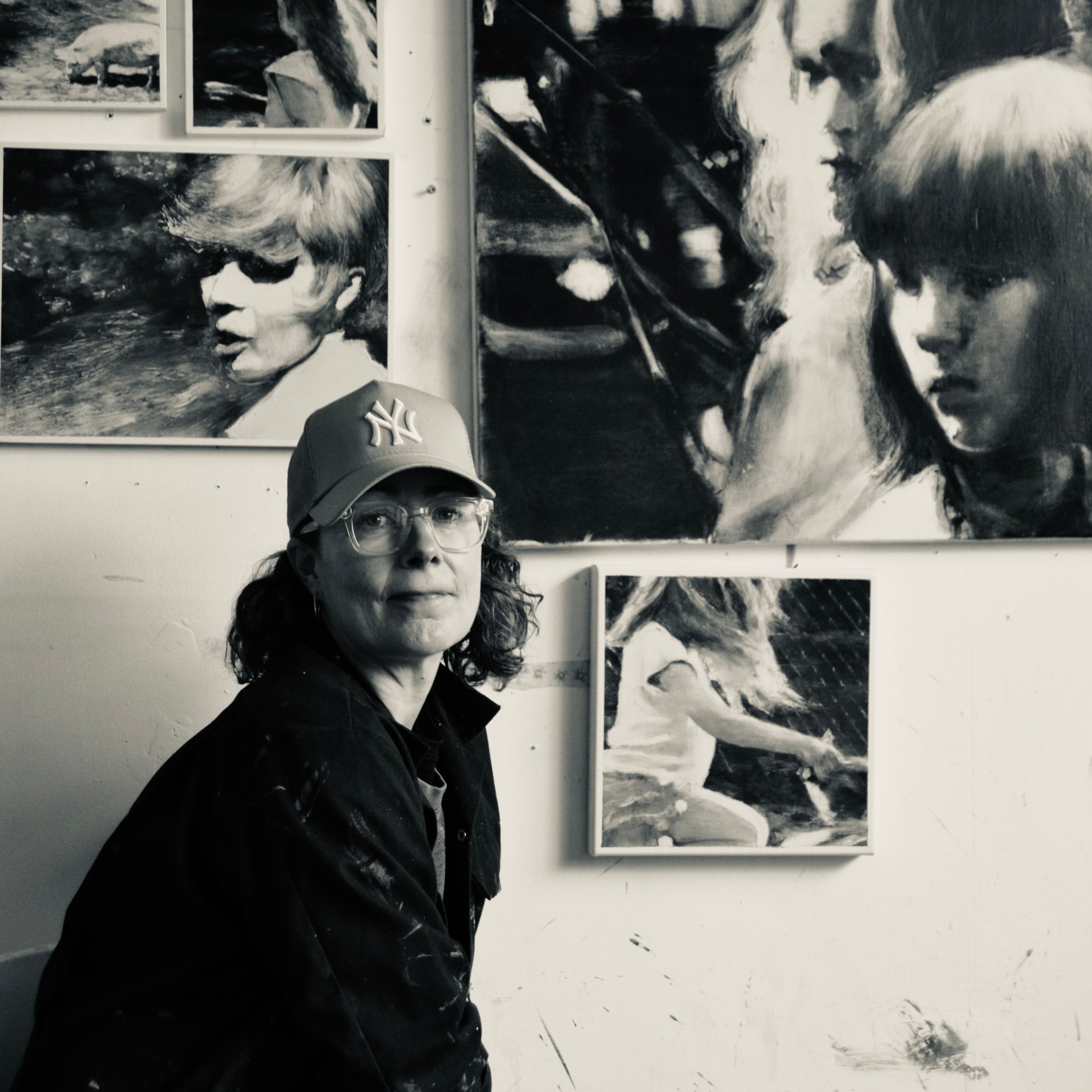
Samantha Fellows is a London‑based painter who works from her studio in Brixton. Born in New York and raised in the UK, she returned to the United States in the 1990s to complete a BFA in Fine Art at Oregon State University. After graduating and moving back to London, she found it difficult to sustain her practice without an artist community or art‑school network, and her painting gradually fell away. During this period, she built a career as a scenic artist for film, television and theatre before returning to painting.
Tell us about your practice. How has it developed over time?
When I returned to London after graduating, I had no connection to an artist community and no network from art school, and I struggled to keep my practice going. However, about twelve years ago, I began rebuilding my fine art practice. Portraiture became a gateway back into painting, and over time I shifted my focus towards contemporary work again. This progression was supported further in 2022 through a year with Turps Art School, which helped me refine both my technique and my confidence in developing a more sustained, intentional practice.
Your work is centred on capturing “split-second moments” – What draws you to these fleeting experiences as a primary subject in your painting? Do you use photography in your process, or does that “snapshot feeling” emerge purely through painting and your technique?
I like the idea of “capturing” these experiences as a subject to my work because this exists in parallel to the actual application of the paint to the painting’s surface. Painting on an extremely slick surface, allowing the oil paint to slip and slide around loosely, again I’m trying to “capture” the exact moment of the image in the slippery paint. Many of the images I work from as references are from home videos which I screen shot – again a sort of parallel to a split-second frame from a moving set of images.
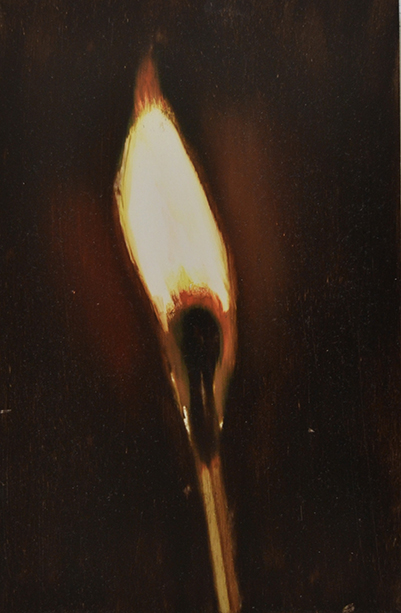
You use translucent glazes of oil paint over a slick, glossy surface, manipulating the paint by dragging, softening, scratching and wiping back. How did this distinctive technique develop, and what does it allow you to express that other paint applications do not?
I’ve always enjoyed painting on plywood panels as they are less fragile than canvases. I realised I preferred it when the gesso primer was heavily sanded so that there was little “tooth” to the surface. I liked the look of letting the white surface shine through oil glazes rather than using white oil paint on my palette, it gives my paintings a more photographic quality. The plastic nature of the colour reminds me of a photographic image developed and printed on a piece of white photographic paper. Now I paint almost exclusively on aluminium panels or white aluminium dibond panels. I love that feeling of the loaded brush pressing against the super smooth surface and how I can then create different textures by pushing various brushes and tools through the glazes, giving unique and somehow tactile depictions of various elements of the scene, such as the dry, scratchy grass.
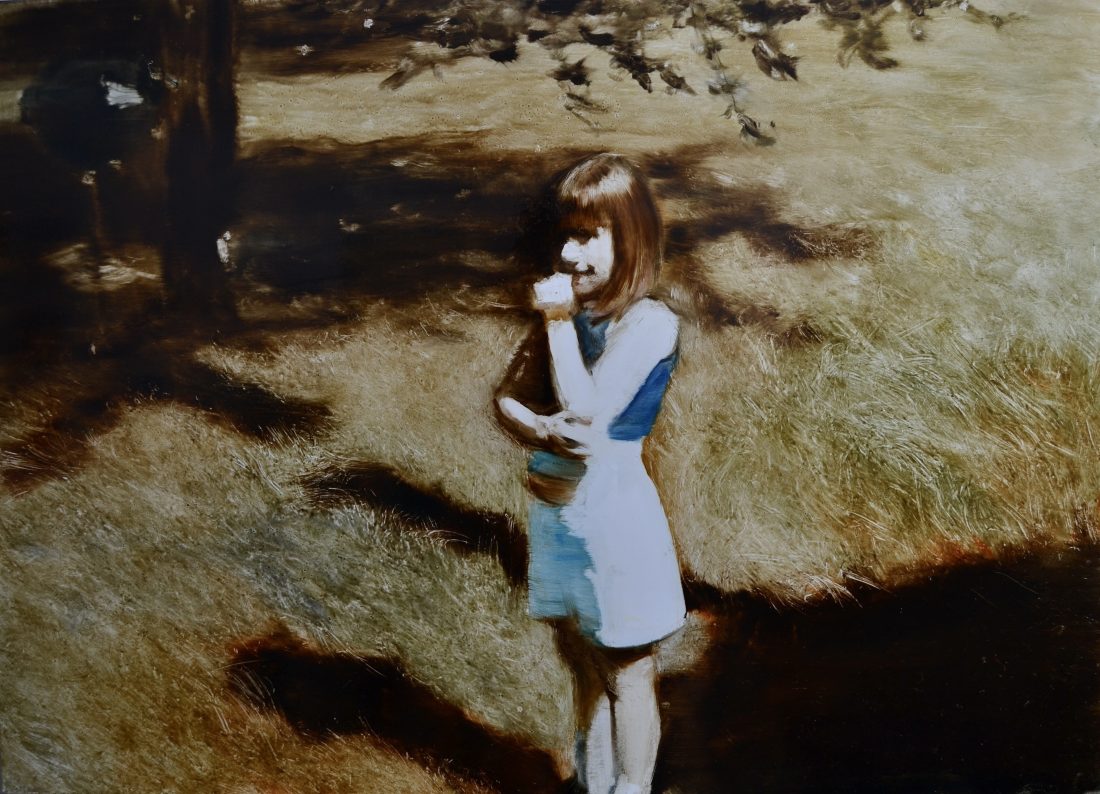
The young female figure stands in strong, almost overwhelming sunlight, creating deep shadows. What role does light play in this work, both visually and emotionally?
I like to emphasise a strong sense of sunlight and intense highlights by wiping back the oily glazes to reveal the bright, white dibond underneath. I like to think that such a strong emphasis and light contrast can trigger the viewer to almost sense it personally. It almost rekindles a nostalgic memory of experiencing hot summer days as a child. Even the feeling of overgrown dry grass tickling their legs or the blazing sun on their shoulders? Or is that stretching it too much?!
There’s a clarity and ambiguity in your work where the image is there, but slightly elusive. How intentional is this balance between the revealed and the obscured?
That is the constant battle – as it is I’m sure for most figurative painters. My paintings work best when the paint exists as a single film across the surface. The act of painting is always a continual cycle of applying the paint, putting the detail in, softening the definition to allow some distance and thin the “film” and then very often, wiping back completely and taking another run at it. I only have about 3 days to paint a painting before the oil paint dries and is no longer malleable. I find painting quickly and instinctively works in my favour, mark-making appears fresh and allows “happy accidents” to occur which keep me from being too tight and overly descriptive. Fairly regularly at the end of the day or the next morning, it’s brutally clear that it all needs to be wiped away again – with an option to start again.
What are you working on now? What’s next?
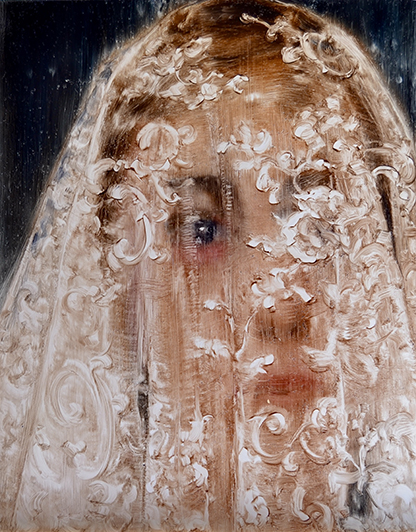
Recently I’ve become a little obsessed with rendering lace – it’s really fun breaking the film of my oil paint with various brushes and silicone shaper tools to describe the texture and patterns of the fabric. And there’s the same push/pull of clarity and ambiguity when describing a face behind a lace veil. Hopefully a full series of works can come from this …
In 2025, Samantha Fellows was selected as one of 26 artists to be part of New Contemporaries. Cynthia out back is currently showing at the South London Gallery until 12 April 2026 and will travel to MIMA later in 2026. She is also showing currently in the John Moores Painting Prize exhibition at the Walker Art Gallery.