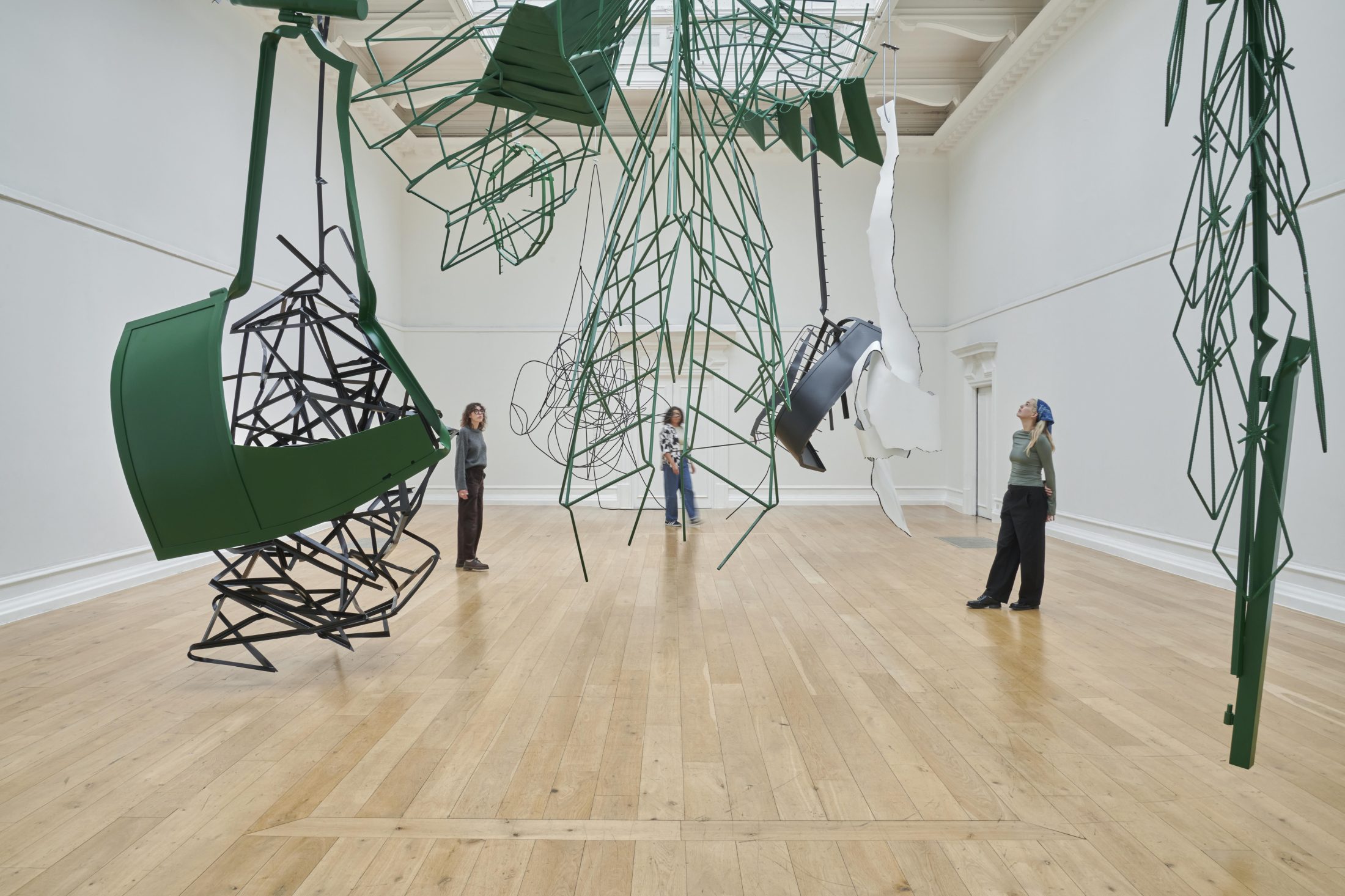
Installation view of Monika Sosnowska: Weight of Matter at the South London Gallery. Photo: Jo Underhill
In a recent conversation held at Camberwell College of Arts, Margot Heller, Director of the South London Gallery, architect Tom Emerson and curator Natalia Sielewicz reflected on the work of Monika Sosnowska and the ideas that shape Weight of Matter.
Spanning the Main Gallery and the Fire Station galleries at the SLG, the exhibition brings together monumental sculptures, concrete forms and architectural structures that transform the familiar into something unexpectedly beautiful.
Rather than presenting architecture as fixed and stable, Sosnowska reveals it as something fragile, mutable and deeply connected to the social and political histories that produce it.
During the conversation, the speakers explored a range of ideas connected to Monika Sosnowska’s exhibition Weight of Matter. , as well as themes that run throughout her wider artistic practice. In this journal post, we highlight three key moments from the discussion that offer insight into her approach from architecture and materials to transformation. To learn more, you can watch the full talk on YouTube.
The Main Gallery: Monumental and precarious
Upon entering the Main Gallery, visitors are met with steel structures suspended from above, appearing improbably light despite their immense physical weight. The suspended works create a powerful dialogue with the gallery itself. They transform a space that many visitors know well, encouraging them to see it anew.
Speaking about the installation, Tom Emerson described the sculptures as “a big three-dimensional drawing in space”, while noting the curious contradiction at the heart of the work: monumental objects that seem almost weightless.
According to Tom, the exhibition title is felt before it is understood. Visitors move between forms that hover overhead, their scale made more dramatic by the soaring Victorian architecture of the gallery. The sculptures appear delicate and airy, yet each is constructed from heavy industrial materials. This tension between material reality and visual perception runs throughout Sosnowska’s practice.
Monika has created a body of work that feels simultaneously monumental and precarious, as if frozen at the precise moment before movement, collapse or transformation.
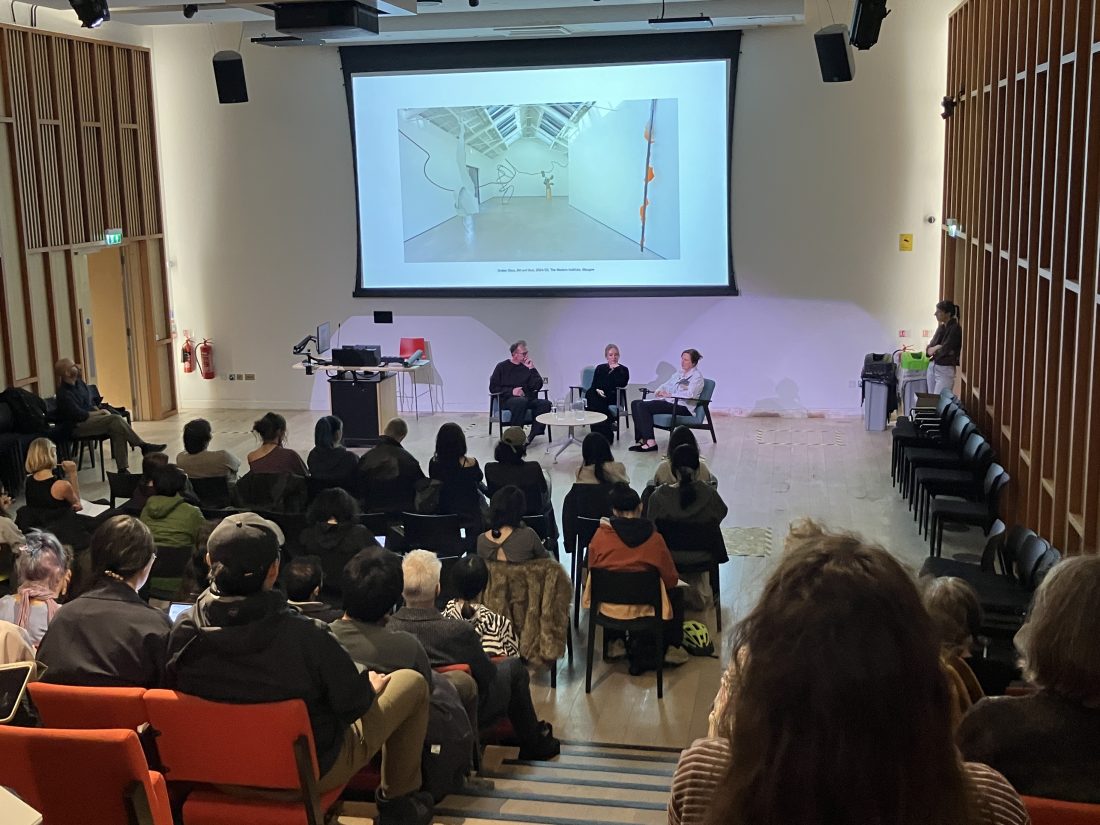
Tom Emerson, Natalia Sielewicz, Margot Heller, Talk: Weight Of Matter. South London Gallery, 2026.
The Fire Station: New sculptural possibilities
While the Main Gallery focuses on suspension and lightness, the works in the Fire Station galleries home in on themes throughout Sosnowska’s practice that bring visitors closer to the ground. Here, concrete sculptures, architectural fragments and maquettes invite reflection on how buildings carry memory long after their original purpose has disappeared.
During the discussion, Natalia Sielewicz described how Sosnowska’s work responds to the changing urban landscape of Warsaw, a city shaped by continual reconstruction, political upheaval and redevelopment. Yet rather than offering a straightforward narrative of loss, Sosnowska transforms familiar architectural forms into new sculptural possibilities.
She also notes that works such as Ballerina, Oyster and Market resist simple interpretation. Their titles invite associations with bodies, objects or places, while their forms remain open and ambiguous. Visitors frequently find themselves searching for human characteristics or narrative meanings within the sculptures, only to discover that the works continually evade fixed readings.
This openness is central to Sosnowska’s practice. As Sielewicz observed, her work does not seek to illustrate history or deliver a clear lesson. Architectural forms are deconstructed and transformed until they become something unfamiliar, encouraging viewers to consider how cities evolve and how traces of the past continue to shape the present.
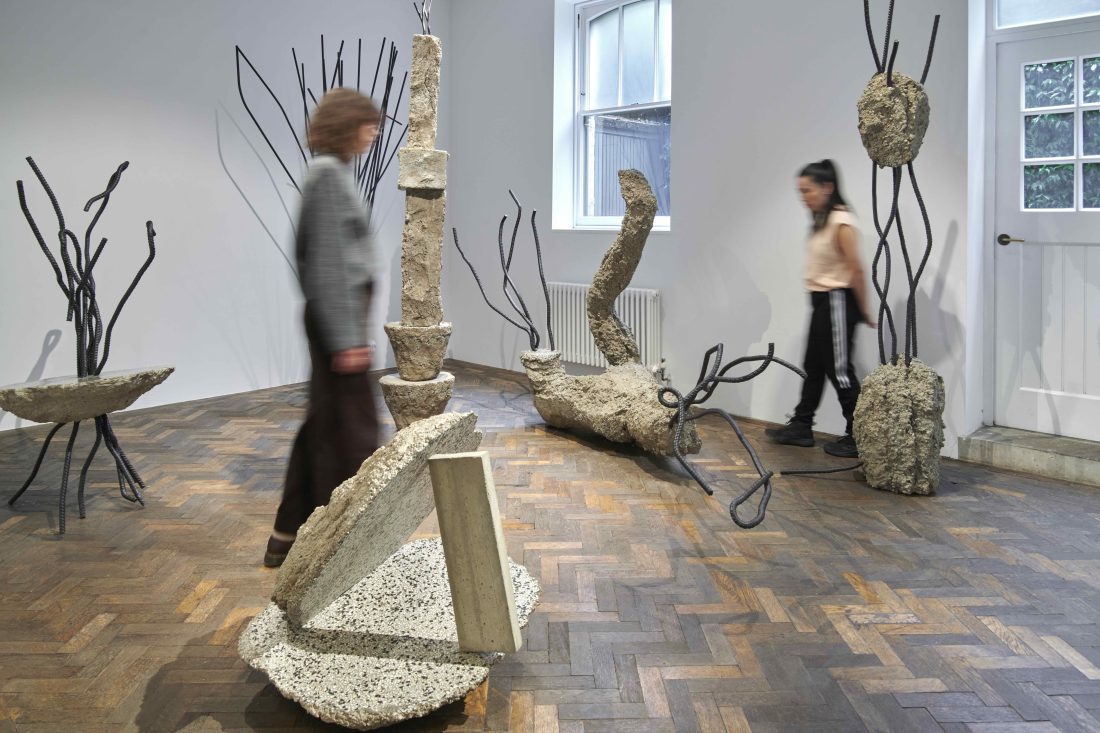
Installation view of Monika Sosnowska: Weight of Matter at the South London Gallery. Photo: Jo Underhill
Revealing Unseen Architecture
Throughout Weight of Matter, Sosnowska draws attention to structural elements that are usually concealed: reinforcement bars, steel supports and the hidden infrastructures that make architecture possible.
Tom Emerson reflected on the significance of reinforcement steel, “Reinforcement was never meant to be seen,” Emerson explained. “You only see it when it fails or when it decays or when it’s being destroyed.” In everyday life these structures remain hidden beneath walls and concrete, taken for granted as part of the fabric of the built environment.
Across the exhibition, materials appear to behave in unexpected ways. Heavy steel resembles folded paper. Concrete becomes delicate and almost organic. Architectural elements lose their practical function and take on a new sculptural life.
For Sosnowska, architecture is never merely a backdrop. It is a record of social ambition, political ideology and lived experience. By exposing its hidden components, she reveals the tensions and contradictions embedded within the built environment.
In Weight of Matter, architecture becomes a language through which larger concerns are explored: memory and change, construction and destruction, permanence and instability. The exhibition invites us to look differently at the structures that surround us and, in doing so, to consider how our environments shape the ways we move, remember and imagine the future.
Monika Sosnowska: Weight of Matter is on view at the South London Gallery. Free to visit until 22 Nov 2026.